
Break the Frame: Most questions about Palestine are loaded. Here’s how to take them apart.

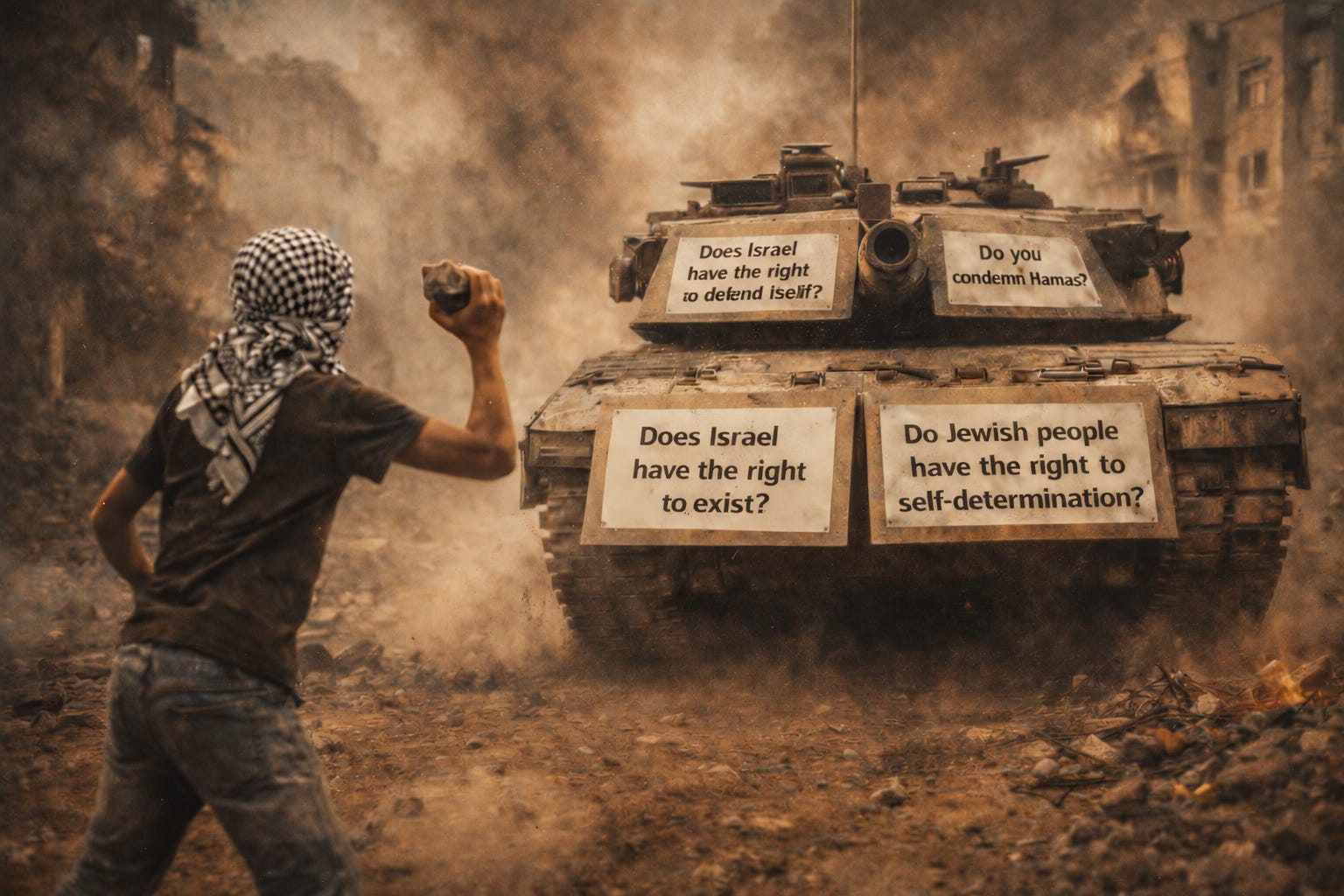
Does Israel have the right to exist?
Does Israel have the right to exist as a Jewish state?
Let’s make those questions easy to answer. Should a state whose creation, survival, and expansion all require the ethnic cleansing of a native population have the right to exist?
There’s only one answer to that. No.
Most of the questions people encounter in Western media, academia, and politics about Palestine are not neutral. They are framed to narrow the issue before you even speak. If you answer them directly, you are already inside a frame that centres Zionism and Israeli legitimacy as the starting point, and treats everything else as a response to it.
You do not have to accept that. There is a simple way to deal with these questions:
Break the frame.
Strip the question down to what it actually asks.
Then answer it.
Start by identifying what the question is doing. Most of the time it is trying to centre one actor instead of millions of people. Or it isolates a single moment and resets the timeline so everything is judged from that point. Or it turns a political and material reality into an abstract moral question so that history, power, and consequences disappear. Or it centres the entire conversation around what is acceptable within a Zionist or Israeli lens.
Say that clearly. You are not answering yet. You are rejecting the terms.
Then strip the question down to what it actually asks once the framing is removed. When you do that, it becomes much simpler. And much harder to defend.
Then answer it.
Take a common one. “Do you condemn Hamas?”
That question is designed to force you to adopt the labels and narrative imposed by the coloniser, including defining resistance as “terrorism” and framing events entirely through that lens. It centres one group and turns the entire issue into whether you accept that framing before anything else can be said.
Strip that away and the question becomes this: do people under colonisation, occupation, and siege have the right to resist?
The answer is yes.
The original question is not really about condemning specific acts. It is about forcing you to issue a single condemnation that reduces everything to “terrorism,” so that everything else becomes secondary to whether you said it.
Once you refuse that, you can be precise on your own terms. The deliberate targeting of civilians is wrong regardless of who does it. But that does not erase the right to resist, and it does not settle the question of what actually constitutes a civilian in a context where occupation and siege infrastructure is embedded in settlements, and where armed civilian populations are integrated into that system and function as part of its enforcement.
Or take “Do Jewish people have the right to self-determination?”
That question is not being asked as a neutral principle. It is being used to justify a specific political project in a specific place, at the expense of another population.
Strip it down and it becomes this: can a claim to self-determination be used to justify settling in a land, displacing its existing population, and maintaining dominance over them?
The answer is no.
Self-determination does not mean the right to create an exclusivist state by removing another people. That is supremacy.
And Jews are not a single nationality requiring a separate territorial state. Jewish people come from different countries, cultures, ethnicities, and languages, and already exercise political rights in the countries they are from and are citizens of, just as Christians, Muslims, Buddhists, or atheists do. The question is not about a general principle. It is about how that principle is being used to justify dispossession and supremacy.
Or “Why is there a double standard applied to Israel?”
That question assumes Israel is being treated unfairly. It recentres Israel as the subject that must be defended.
Strip it down and it becomes this: should a state that has been built through displacement, and that continues to control, dispossess, and murder another population with complete impunity, be held accountable for that or not?
The answer is yes.
The real double standard is the impunity itself. The fact that these actions are defended, justified, or ignored, rather than treated as unacceptable and punished.
Or “What would you do after the October 7 attacks?”
That question isolates one moment and resets the entire timeline around it, which is why it is the wrong question to begin with. The question that needs to be answered is this:
What should Palestinians in Gaza do after their land and homes were taken to create Israel, and after decades of occupation, blockade, and repeated military assault? After diplomacy and peaceful resistance were met with colonial terms, bullets, and bombs? And what should they do now, after genocide?
Or “Does Israel have the right to defend itself?”
That question assumes that an entity engaged in colonisation and occupation can frame its actions as self defence.
Strip it down and it becomes this: does a colonising power have the right to use force to maintain what it has taken, and does an occupying power have the right to enforce that occupation through violence?
The answer is no.
Within its borders, Israel was created through displacement and continues to structure itself around that, since a Jewish majority is treated as a precondition of a Jewish state. In the West Bank, Gaza Strip, and East Jerusalem, it is an occupying power, as repeatedly affirmed by bodies such as the United Nations. The same logic extends to places like the Syrian Golan Heights, and more recently, into southern Lebanon. Framing all of this as self-defence, particularly for a state with expansionist ambitions, is part of the same distortion.
Or “Why don’t Palestinians accept peace?”
That question assumes a fair and viable peace was offered and rejected.
Strip it down and it becomes this: are people required to accept a coloniser’s terms that leave them fragmented, without sovereignty and the ability to defend themselves, and under continued control?
The answer is no.
Peace is not submission. It has to mean an end to domination, not a continuation of it under different terms.
Or “If Hamas disarmed, wouldn’t there be peace?”
That question centres disarming resistance as the solution, while leaving everything else untouched.
Strip it down and it becomes this: why is the focus on disarming the people under occupation, rather than ending the occupation and dismantling the structures that enforce it? Why is the burden placed on the oppressed rather than on the oppressor and the system producing the conditions they are resisting?
The answer is no. Disarming resistance does not bring peace if the conditions that produce it remain.
You are not avoiding the questions when you do this. You are rejecting a frame that centres one perspective and treats it as the default. You are rejecting a Zionist lens of Israeli legitimacy.
Break the frame. Strip the question down to what it actually asks. Then answer it.
Another excellent posting Cris.